Beyond the "Delete" Button
By Jan Brown
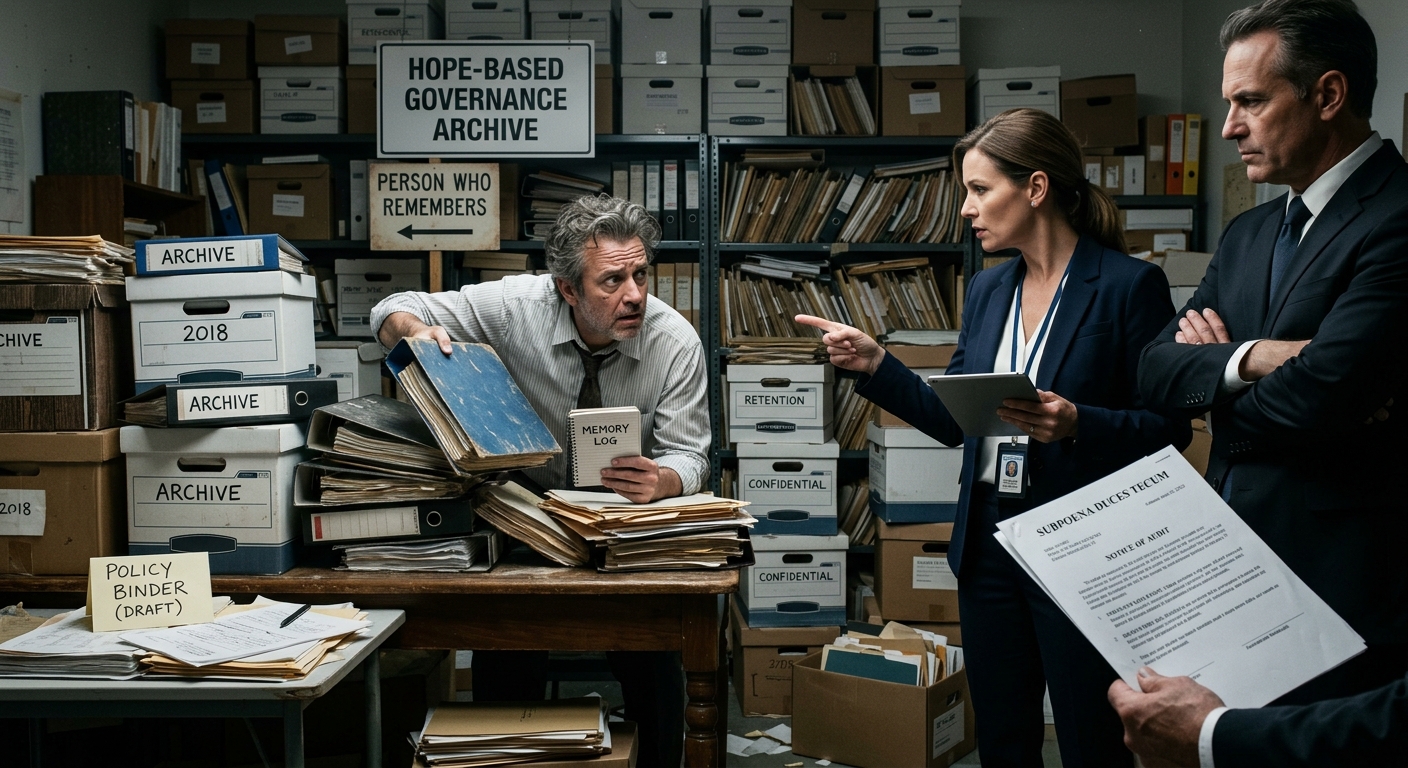
In the high-stakes arena of modern data governance, most organizations are operating on what can only be described as a "hope-based" strategy. We draft complex retention schedules and policy binders, but when a regulator or a legal adversary demands proof of compliance, the entire system typically rests on "the person who remembers." Relying on human memory isn't a strategy; it’s a liability waiting for a subpoena. In an adversarial audit, "I didn’t know" or "I think we deleted that" is a losing hand. To survive the era of rigorous oversight, organizations must stop trusting individuals and start verifying evidence.
Replacing Human Memory with Automated Evidence
Every retention policy makes two fundamental promises: first, that an archive is a complete, unaltered mirror of the source system; second, that when its time is up, the data is destroyed properly—and only when legally permissible.
Road replaces the fragility of memory with the permanence of evidence. Whether it is a structured database or an unstructured file share, the system treats them with identical rigor, unifying your governance under one umbrella. The process begins before the data even enters the system via the deposit record, establishing a chain of custody for how the data was transferred and by whom.
Upon archiving, Road generates a signed, timestamped extraction manifest detailing the exact queries run, the rows returned, and a SHA-256 digest of every file. It doesn't stop there; the system re-checks these digests on a schedule you set, providing a dated, verifiable answer to the question of integrity.
"In most organizations, the only thing standing behind either promise is a person who remembers. Road replaces that memory with evidence."
Reflection: From a strategic standpoint, a "dated answer" supported by cryptographic digests is the only defensible position. It shifts the burden of proof from subjective human recollection to an objective, immutable record that can withstand the most aggressive scrutiny.
The "Tombstone" – Why Deletion Requires a Birth Certificate for its Death
In a defensible disposition framework, "deleting" data is not a simple act of erasure; it is a formal, evidentiary event. When data reaches its expiration, it doesn't just vanish. It triggers an approval chain of named individuals. Only after the final approval is the data destroyed, and in its place, Road generates a signed destruction manifest.
This creates a permanent "tombstone"—a record signed and timestamped with the same level of cryptographic rigor as the original archive.
To ensure this is accessible to human auditors, the system produces an Archive Declaration Document, a plain-language statement of what was archived, by whom, and when. Furthermore, the system protects the integrity of the process by placing the digest of the inventory (files.csv.gz) inside the signed manifest.json, ensuring the record of what existed can never be edited.
"So what survives the data is the proof that it left lawfully. One unbroken chain of custody from the source system to the certificate of destruction."
Reflection: It is a counter-intuitive principle: once the data is gone, your most valuable asset is the proof that its exit was deliberate and authorized. The tombstone is the birth certificate for the data's death, proving the organization followed the law to the letter.
Trust, But Verify (Independently)
A defensible archive cannot be a "black box." If your proof is trapped in a vendor’s proprietary format, it isn’t evidence—it’s a hostage. True defensibility requires that signatures are verifiable using standard, independent tools like OpenSSL.
The system utilizes independent third-party "trust anchors" via RFC 3161 timestamp authorities. This proves when an archive was signed based on an external clock, preventing backdating. While the bundle includes a signing_key.pem as a convenience copy for quick verification, the real legal weight is anchored to the public key registered within the Road platform.
To ensure total independence, every archive contains:
manifest.json: The signed document describing the archived data and its digests.
timestamp.tsr: A cryptographic token from an independent timestamp authority.
verify.txt: Clear, step-by-step instructions to verify the archive using OpenSSL, ensuring no vendor lock-in on your proof.
Reflection: Third-party trust anchors provide the necessary distance between the organization and the evidence. By anchoring the proof in independent clocks and standard tools, you ensure the integrity of your data is universally recognizable and legally robust.
The Library of Congress Standard for Corporate Data
Corporate data is often treated like disposable trash, yet the legal requirements for its preservation are increasingly permanent. To bridge this gap, the system utilizes "BagIt" (RFC 8493), a digital preservation standard developed by the Library of Congress.
When data is deposited, Road detects the BagIt manifest and verifies the files against the sender's original SHA-256 checksums computed at the source. It doesn't just check what it stores; it verifies what it received against what the sender said they sent. If they disagree, the system flags it immediately.
Reflection: Adopting the Library of Congress standard for business archiving is a powerful statement of intent. It elevates "backups" to "digital preservation," applying the same rigor used for our historical record to your corporate liability.
The Hierarchy of Compliance (Policy vs. Litigation)
Automation is a tool, not a master. In a professional governance environment, the hierarchy is clear: litigation holds always outrank retention policies.
If data is flagged under a legal hold, the automated destruction process is instantly frozen at the approval chain. The data remains preserved until the hold is explicitly lifted. Crucially, the "approver" in the chain has a real choice, not a rubber stamp. If an approver rejects a destruction request, they must provide a specific reason, which is then entered into the permanent record.
Reflection: The stakes are too high for "accidental" deletions. By requiring a human to acknowledge the destruction and record the reasoning for any rejection, the system turns a bureaucratic step into permanent compliance evidence.
Conclusion: A New Standard for Digital Custody
The shift from "trusting a system" to "verifying evidence" is the modern enterprise's new mandate. By leveraging cryptographic signatures, independent timestamps, and standardized formats like BagIt, organizations can finally move beyond the "pinky promise" of manual logs and administrative memory.
As you look at your own data stacks, ask yourself: If you were forced to prove in court tomorrow that a specific dataset was handled lawfully from capture to destruction, could you do it without calling a witness? The value of your governance is not in the data you keep, but in the unbroken chain of custody you can prove.