ROAD 26.08 is here!
By Jan Brown
ROAD 26.08: AI Analysis Under Budget Control, a Reporting Engine, and a Platform You Can Talk To
infoCorvus ships governed AI cost control, visual reporting, an MCP server for conversational operations, and three new cloud data platforms
Most enterprises evaluating LLM-driven content analysis stall on the same question: what happens when the job doesn't stop. Point a model at a million documents and the invoice is unknown until it arrives. That uncertainty is the reason AI classification projects sit in pilot for a year instead of running against the full estate.
ROAD 26.08 answers that question with a number you set in advance, not one you find out after the fact. It also adds a visual reporting engine, opens ROAD itself to conversational AI assistants, and extends platform coverage to three more cloud data targets. Here is what changed, and why each piece matters to the people who have to defend the decision.
Govern: a budget the platform enforces, not a policy people are asked to follow
The starting point for this release is control, not capability. LLMs can classify, summarize, and tag enterprise content at a scale no manual review process can match — but only if the organization running the job can guarantee what it costs and where the money went.
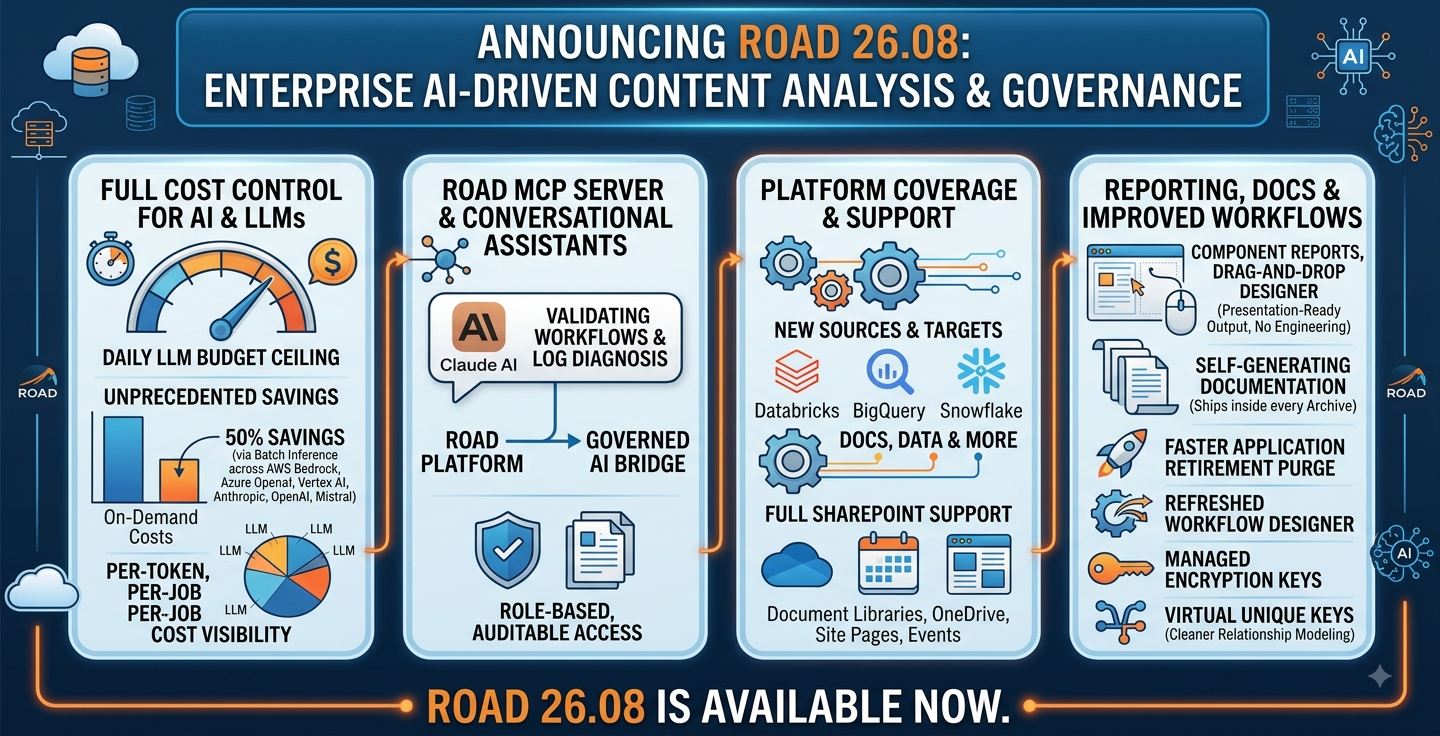
ROAD 26.08 gives every organization a daily LLM budget. As a large analysis runs, work is held or halted the moment that ceiling is reached. Nobody discovers a runaway job by opening a bill. You set the number you're comfortable with, and ROAD holds the line — which means an analysis can be pointed at a full document estate, not a sample, without an open-ended cost commitment.
Underneath the budget sits full cost visibility: ROAD records input and output token counts for every LLM interaction and applies per-model pricing you configure, attributing cost down to the individual job, application, and service. A dedicated LLM Services page, a spend chart, and a downloadable job history show exactly where every unit of budget went — before anyone commits to a larger run.
ROAD 26.08 also submits content analysis through the batch APIs of AWS Bedrock, Azure OpenAI, Google Vertex AI, Anthropic, OpenAI, and Mistral. Batch inference is typically discounted by around 50% at most providers, and ROAD captures that saving automatically, with no change to extractors already configured. Lower cost per job and a hard ceiling on total spend are not competing goals here — this release delivers both.
Reduce risk: documentation that travels with the data, encryption you control, and a reporting layer that doesn't require an engineer
Governed cost control is one form of risk reduction. This release adds three more.
Documentation that writes itself, and stays with the archive. ROAD now generates complete documentation for every application type — data source, tables, subsets and layers, transformations, extraction configuration, run parameters, encryption keys, and relationships, illustrated with diagrams and formatted for printing. The documentation ships inside the extract itself. Years later, when the people who built the application have moved on and the source system is decommissioned, whoever opens that archive finds a full account of what it contains and how it was produced — inside the archive, not in a wiki that may no longer exist. Workflows get the same treatment: a readable, node-by-node specification of what each one does.
Encryption you manage, not a black box. Archived data can now be encrypted with keys you manage, symmetric or asymmetric. Keys are first-class objects in ROAD with stable identifiers, and encryption is honored throughout — in autonomous deployment and purge, and in the application documentation, which records the key an archive was produced with. A decryption utility ships with the documentation, so an encrypted archive remains readable independently of ROAD.
Component reports: presentation-quality output without a development cycle. ROAD 26.08 introduces a drag-and-drop, block-based report designer. Assemble a report from tables, forms, layouts, free HTML, images, and charts — each block drawing from its own SQL or Groovy data provider, nesting freely. Style controls, background colors, external CSS and JavaScript resources, and column renderers that carry through to CSV and Excel downloads mean a branded, presentation-ready report is something anyone who understands the data can build in minutes, not a ticket that sits in an engineering backlog. A new Report application type lets teams publish over archived data without configuring a separate extraction.
Faster Application Retirement Purge — deletions now execute in parallel according to table dependencies — and a comprehensive interface refresh round out this release's risk and operations improvements.
Enable AI: ROAD opens to conversational assistants, on your terms
ROAD has exposed archived data to AI assistants for some time. ROAD 26.08 goes further and exposes the platform itself. Connect Claude, or any MCP-capable assistant, and hold a conversation about your ROAD environment.
Two capabilities customers asked for most are now live. The assistant can validate applications and workflows — check a configuration, test a database connection, test a file system source, and report back in plain language what's wrong and where, before anyone commits a run to the schedule. It can also analyze logs and diagnose issues: read extract logs and workflow execution logs, list running and completed jobs, and inspect the status of any one of them, citing the relevant lines instead of leaving someone to scroll through output looking for a cause.
Beyond diagnosis, the assistant can inspect applications, data sources, file system sources, extensions, workflows, and executions — and, when permitted, start and stop them. Read tools and execution tools are kept separate, so the organization decides exactly how much authority the assistant is granted, and every action runs under the same authentication as the rest of ROAD. This is the same principle behind Governed AI Bridge applied to ROAD's own operations: an AI agent is treated as a user, with a role, and everything it does is auditable.
The ROAD User Manual has been reorganized into a fully navigable structure, served directly by ROAD and searchable by AI assistants through a dedicated documentation search tool — new chapters on extensions, injectables, report parameters, workflow conditions, discovery scanners, and LLM extractors mean an assistant can answer questions about ROAD correctly, and act on them.
At scale: three new platforms, and an estate that finally includes SharePoint
Data governance only holds up if it covers where the data actually lives. ROAD 26.08 widens that coverage significantly.
Databricks, BigQuery, and Snowflake. Databricks and BigQuery join Snowflake, PostgreSQL, Oracle, and SQL Server as supported data targets. Databricks support is built for enterprise deployment: OAuth machine-to-machine service principals, Microsoft Entra ID and Azure managed identity authentication, managed storage locations, high-throughput loading, and archived data declared as Delta tables so it's immediately queryable as a lakehouse asset. BigQuery loads through Cloud Storage staging and Google's native load-job API. Databricks and Snowflake also become data sources — an organization can now archive from a lakehouse or cloud warehouse as readily as it archives into one, with native type classification and full key discovery on both.
SharePoint, fully in scope. SharePoint is now a supported File System data source. ROAD walks document libraries and OneDrive, retrieving documents, Site Pages, and calendar Events, with SharePoint's own metadata carried on each file. A dedicated SharePoint Filter scopes an analysis or archive to chosen sites and OneDrive accounts, external and guest accounts are excluded from OneDrive discovery, and the walk runs in parallel so large tenants complete in a practical timeframe. Combined with the LLM analysis described above, an entire SharePoint estate can be inventoried, classified, archived, and retired under governance — one of the largest, least-governed content sprawls most enterprises carry.
Two structural improvements make the rest of this easier to build and maintain. Virtual Unique Keys (VUKs) let an organization declare, once, which columns uniquely identify a row in a table, with Virtual Foreign Keys now defined against that named VUK and a Validate button to check it against real data before anything is built on top of it. And the workflow designer got a substantial refresh — copy/paste nodes, one-button auto-arrange, full-screen property panels, audited workflow actions, and per-worker node targeting — for the teams building and maintaining these pipelines every day.
What this release means
Every enterprise running LLMs against a large document estate faces the same tension: the classification and discovery work is valuable, but the cost and the access it requires are hard to bound in advance. ROAD 26.08 is built around resolving that tension in the platform, not in a spreadsheet someone maintains on the side. A budget the system enforces. Documentation that survives the people who wrote it. A reporting layer anyone can use without an engineering ticket. An AI assistant that operates ROAD under the same role-based, auditable access as everyone else. And a data estate — including SharePoint, Databricks, and BigQuery — that's finally fully in scope for governance rather than partially covered by exception.
ROAD 26.08 is available now.
Talk to us
If your organization is weighing an LLM classification project against an unknown bill, or has a SharePoint estate nobody has fully inventoried, that's the conversation worth having first. Contact infoCorvus to see ROAD 26.08 against your own environment.
Meta description: ROAD 26.08 adds budget-controlled LLM analysis, visual reporting, an MCP server for conversational operations, and Databricks, BigQuery, and SharePoint support.
Related reading:
- Governed AI Bridge: how ROAD exposes enterprise data to AI agents under role-based control
- Application Retirement: why legacy systems keep costing money long after their business value fades
- Data Warehouse Ingestion: standing up governed pipelines into Snowflake, Databricks, and BigQuery without a custom engineering project